
Click for .pdf file.
MAINE CENTRAL
DAIRY, HEATER, PRODUCE, & REFRIGERATOR CARS, 1901-1938
Introduction
The Maine Central Railroad served a region that included areas of valuable agricultural production, and as the railroad entered the 20th century, management found themselves in need of specialized rolling stock to handle that originating traffic. In addition to 13 cars on the roster in 1901, the MEC would add another 1136 insulated cars to its fleet from 1902 to 1923 (the early cars were all retired by 1910, and not addressed further here). Included among such freight cargoes were: apples, butter, cream, and potatoes. As demand for additional fluid milk continued to climb, subsequent decades also found increasing need for milk can cars, and the railroad would acquire and convert insulated cars for such traffic capable of being handled in passenger trains. In that service, the milk cars were seen traveling to southern New England cities such as Boston, MA, and Providence, RI. The dairy industry's increasing move to bulk milk tank cars from the late 1920's, however, would in turn reduce the need for can cars. Consequently, many cars would be retired early or converted for other, more general use.
Click for .pdf file.
The Refrigerator Cars
The MEC purchased two groups of wood underframe refrigerator cars from MDT in 1902 and 1904, numbered 1450-1464 and 1465-1474. Nearly all of these were retired in the late 1920's, but one soldiered on until the middle of the next decade. These cars may have been used for a variety of commodities, as listed above. No photos or diagrams are yet available.
The Dairy Cars
Car 1475 arrived from Standard Steel Car Co in 1908, as a one car lot. Designated a "Dairy Cars" by the railroad and suitable for butter, cream, and milk, this car had swinging reefer doors, but no ice bunkers, as did all the following dairy cars. Equipped with a more durable steel underframe, this car served until 1937.
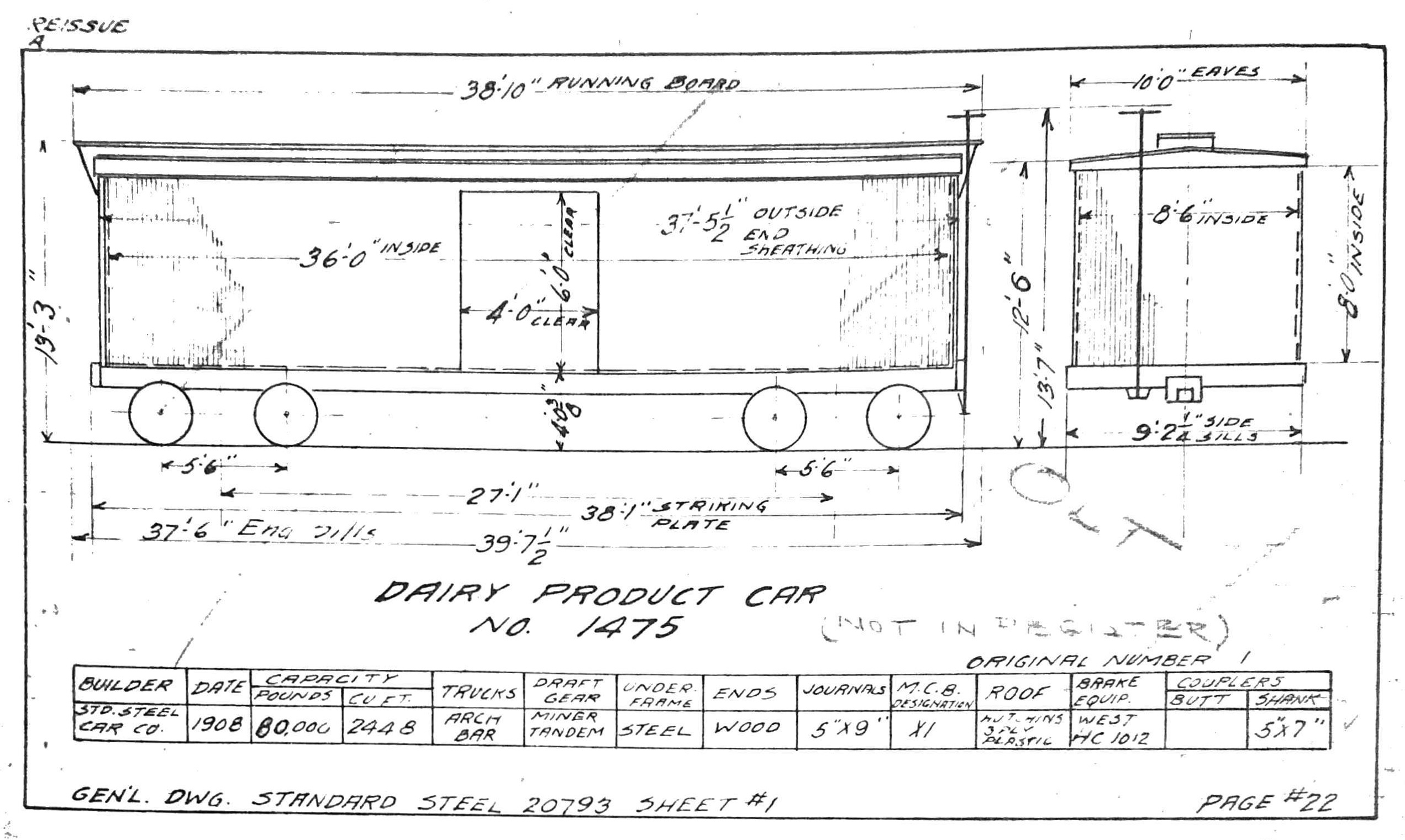
MEC diagram for car 1475, built by Standard Steel Car Co., 1908, click for full size.

MEC 1475, SSC photo, 1908
The MEC acquired more SUF dairy cars from Keith Car Co of Sagamore, MA, 1910, numbered 1425-1449. These cars used a characteristic KCC underframe with a side sill that ran only between the body bolsters; this construction was used on many box cars sold to the B&M, NYNH&H, and MEC during the same period. Nearly all of these were retired in the mid 1930's.

MEC 1444 (2nd,) unk date (1926-1937,) cropped from larger image, David G. Larrabee collection, click for full image.
The MEC would order three more lots of 36' insulated box cars from Keith Car Co in 1913, 1918, and 1919. These cars would be the most common design of dairy car owned by the railroad, with 75 cars total. While these had a very similar side sill arrangement compared to the group purchased in 1910, the cars were 6" longer in outside length, and the straight center sill was replaced by a shallow built-up fishbelly center sill. The cars may have been better insulated than their predecessors as well, as the interior dimensions were both 6" inches shorter and narrower. The first two lots were originally outfitted for freight service only, while the last group came equipped for service in passenger trains. By 1930, these can cars were beginning to become surplus as the milk traffic began to be shipped in leased milk tank cars, and the MEC elected to rebuild some of the cars as general service box cars. However, 6 of the 1918-built cars were also re-equipped for passenger service at the time.
One group of documented examples of these cars in service in New England can be found in a passenger conductor's train records on the WN&P Division from May 1925 to Aug 1926, held in the B&MRRHS collection. B&M Train 822, a morning run from Portland to Worcester, included a MEC dairy car in 5 of 22 days' trains documented. Cars numbered include: 1513, 1515, 1519, and 1522 (twice,) all built by Keith in 1918. While the cars' origin is unknown, they were all destined for Providence, RI, and were likely handed off to the NYNH&H at either Lowell or Worcester. Prior to Turner Centre System's 1928 purchase by H. P. Hood, they operated an important city plant at Providence; it is likely these cars were in TCS service at this time.
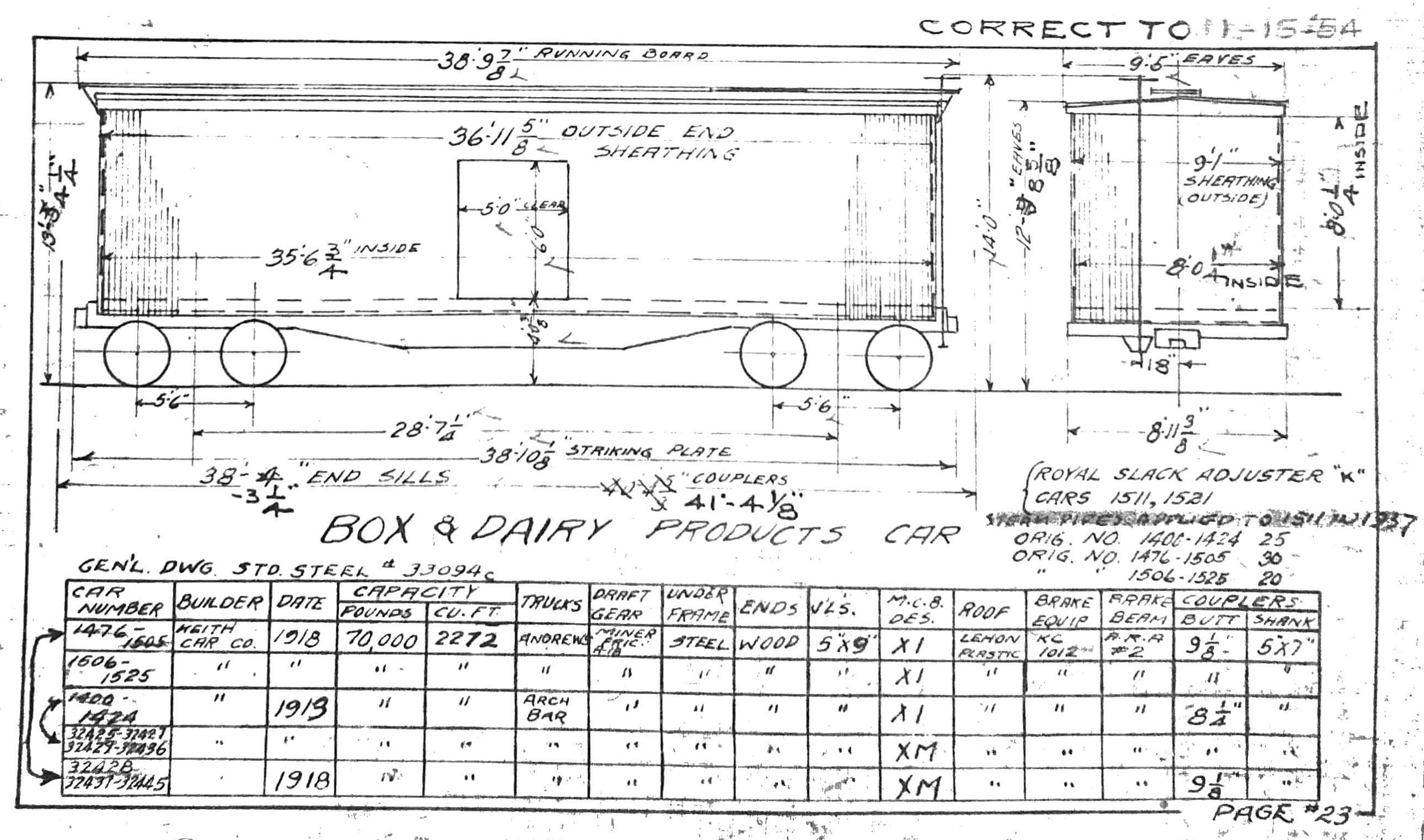
MEC diagram for cars 1400-1424 (1913,) 1476-1505 (1918,) and 1506-1525 (1919,) all built by Keith Car Co., click for full size.
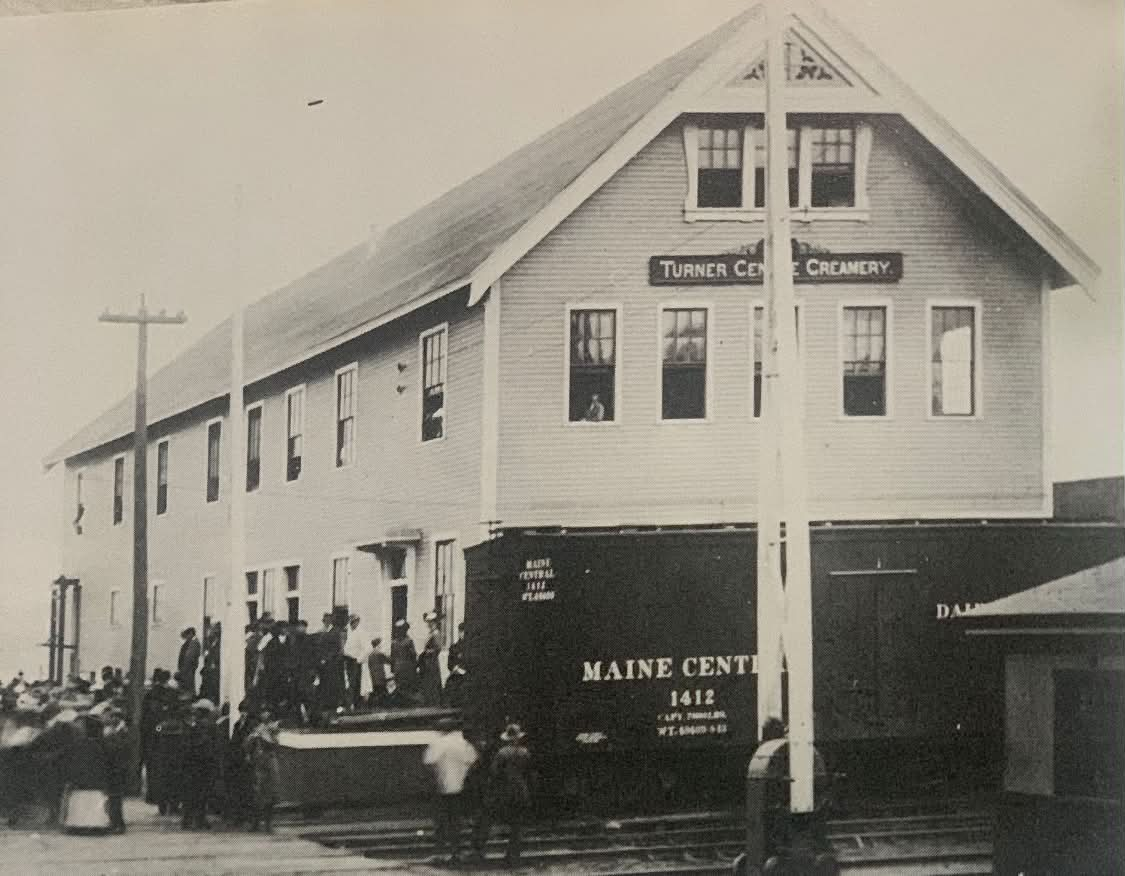
MEC 1412 at the newly opened Turner Centre System facility in Wiscasset, ME, 1913, Albion Maine Historical Society collection, click for full image.
The MEC's last purchase of dairy cars came from Standard Steel in 1923. Purchased at the same time the company was also acquiring box cars from the builder, these had a unique steel frame construction not known to be repeated on milk cars anywhere. Some of these cars would be rebuilt with steel ends at MEC shops and continue in service until well after WWII.
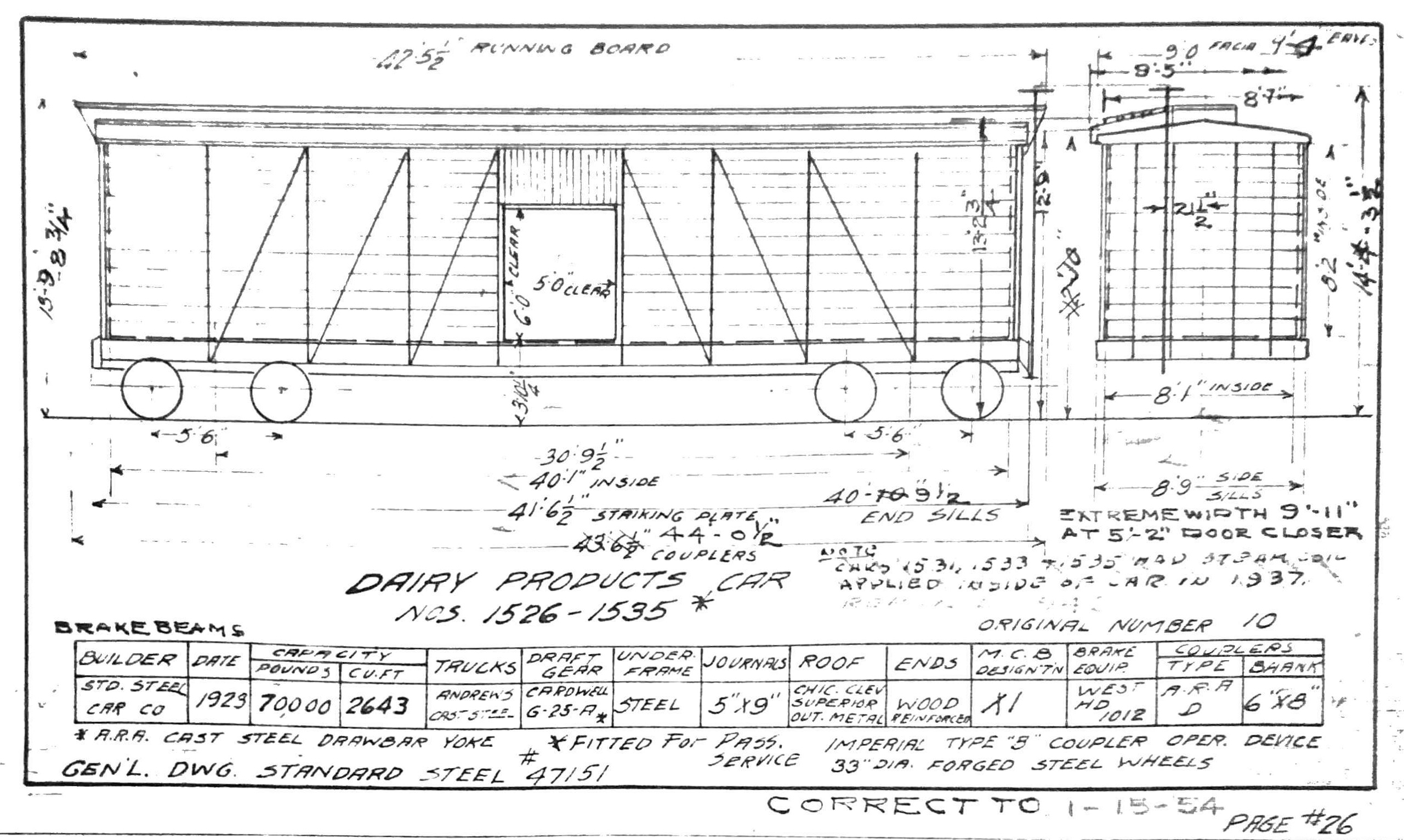
MEC diagram for cars 1526-1535, all built by Standard Steel Car Co., 1923, click for full size.

MEC 1526, SSC photo 1039, 1923, courtesy Keith Retterer, click for full size.
Note: this paint scheme was intended for the builder's photo only; it is unlikely this scheme would have ever appeared in MEC service.
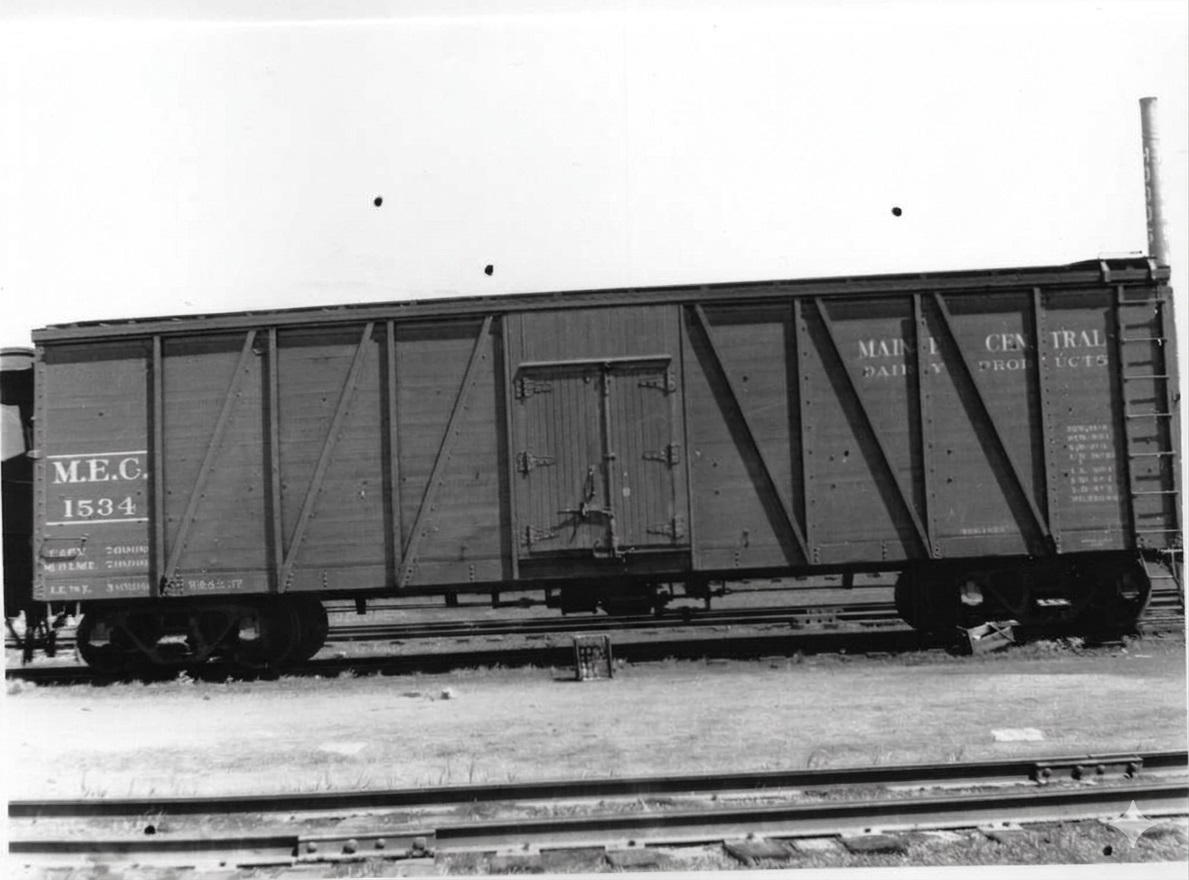
MEC 1534, at H.P. Hood in Charlestown, MA, late 1930's (car was reweighed in Dec '37), Al Armitage photo, click for full size.

MEC 1532, SSC 1923, courtesy Allan Houghton, click for full size
The Heater Cars
The MEC's Eastman Heater cars have a separate webpage HERE.

MEC 65255, ca 1910, click for full size

MEC 65545, Laconia Car Co photo, 1912, Wayne Gebhardt collection, click for full size
Posted 3/29/25. Updated 8/23/26. Maintained by Earl Tuson